
The simple parenting classes helping fathers win back their children's hearts
September 14, 2025
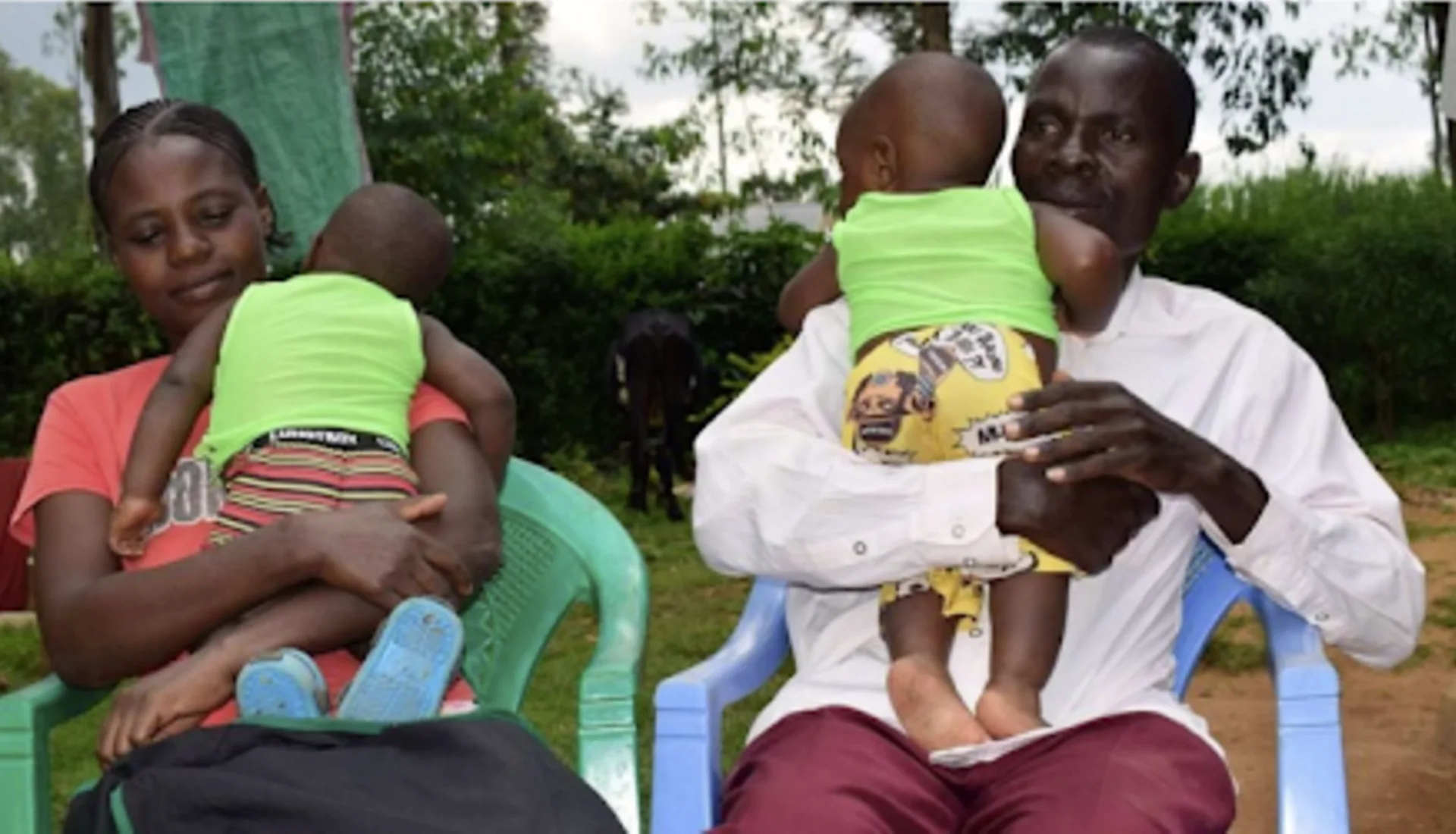
Victor and his wife Priscah cradle their 11-month-old twins at their home in Homa Bay County. The parents of four say the ECD programme has transformed their family bond, bringing them closer together as a unit.
What you need to know:
- Fathers in rural Homa Bay County who were once distant providers are transforming into hands-on parents through an Early Childhood Development programme.
- Children who once couldn’t recognise their fathers now race to greet them, while wives finally receive the parenting support they’ve long needed.
The afternoon sun beats down on the dusty path leading to Victor’s home in Sidika Village, North Kabuoch. As he approaches his modest homestead after attending an Early Childhood Development fun day at Obera Boys High School, two pairs of eager eyes spot him from far.
His 11-month-old twin boys immediately break into excited crawls, racing across the floor toward their father with pure joy. It’s a scene that would have been unimaginable just two years ago—when Victor was merely the man who left money on the table and disappeared into his own world.
The minute he arrives, you can see the bond,” observes his wife, Priscah relief washing over her face as she watches her husband scoop up the twins. For her, this moment means she can finally attend to other household tasks while the children are in capable, loving hands.
The awakening
Victor’s transformation from distant provider to engaged father didn’t happen overnight. For most of their 11-year marriage, the 32-year-old father of four—two daughters and two sons—followed a familiar script: work hard, bring home money, and leave the child-rearing to his wife.
“The better part of those years, my wife was solely involved in raising the children,” Victor admits. “But recently, both of us enrolled in an Early Childhood Development program initiated by the Lake Region Development Program.”
The program opened Victor’s eyes to a world he never knew existed—one where fathers play active roles in shaping their children’s emotional, social, and cognitive development from the very beginning.
“From the training, I learned that the bond between a child and parents starts from conception,” he explains, wonder still evident in his voice. “I didn’t know babies can hear your voice while in the womb and they will recognize it even after birth.”
The revelations kept coming: the critical importance of exclusive breastfeeding for six months, the need to feed babies with clean cups rather than bottles, and countless other insights that transformed how he viewed parenthood.
Today, Victor’s mornings look radically different. As dawn breaks, he heads to the cow shed to milk the cows while Priscah cleans the house and prepares their daughters for school. By the time she’s finished with breakfast, he’s ready to escort the children to school before heading to the farm.
“It has become easier to implement what we were taught about nurturing our children,” Victor reflects. “Communication within our family has improved tremendously.”
For 27-year-old Priscah, the change has been life-altering. “There are so many benefits now. When I’m busy, the father picks up the children, plays with them, and even helps with their homework,” she says, her smile revealing how much this partnership means to her.
The children’s attachment to their father speaks volumes. “Whenever he leaves, they’re either running after him crying or asking him to carry them along,” Priscah laughs. But beneath the humour lies a profound truth about the security children feel when both parents are emotionally available.
Generational patterns
Victor knows this transformation intimately. The father of a five-year-old son carries his own story of awakening, one marked by the painful realization that his child barely recognized him.
“From work, I would shower, go out, and return late at night,” he recalls. “It reached a point where my son couldn’t recognize me.”
His only interactions with children had been professional—during immunization programs and treating sick children as a community health volunteer. The irony wasn’t lost on him that he cared for other people’s children while remaining a stranger to his own.
“I never had interest in child development. I hardly played with the children—in fact, I was harsh. Now I understand why they were so detached from me,” he admits.
The turning point came when Victor recognized the cycle he was perpetuating. Having grown up without parental love due to his parents’ separation, he was unconsciously repeating patterns of emotional absence.
“I never enjoyed parental love, but I have since learned to rewrite history by giving my child the attention he deserves,” he says with quiet determination.
Now, Victor deliberately carves out time after work to play with his son.
“I have learned the importance of play in brain development. My interaction with him has helped me understand his needs and given him room to express himself openly.”
The ripple effects
The changes extend beyond playtime. Both fathers describe revolutionary shifts in how they handle discipline, moving away from harsh punishment toward dialogue and understanding.
“In terms of discipline, I’ve embraced alternative ways rather than being harsh and aggressive,” Victor explains. “When my boy is wrong, he’s quick to dialogue with me now.”
Victor Omondi echoes this sentiment: “We’ve learned to express ourselves freely and iron out issues in our marriage with ease and trust.”
The Lake Region Development Program operates across North Kabuoch, Kanyamwa Koloo, and Kanyamwa Kosewe wards within Ndhiwa Sub County, Homa Bay County. Program officer Mercy Sitawa explains their strategy of working with groups of 10 caregivers who meet monthly for training on responsive and protective parenting.
Currently, they run two all-male caregiver groups, each with 10 members—a deliberate choice that recognizes the unique role fathers play in family decision-making.
“We have seen that bringing men on board is very important, since men are decision makers in the home,” Sitawa notes. “Many fathers who have gone through the training have admitted they are much closer to their children.”
The training covers crucial modules including nutrition, play, and brain development, targeting children aged 0-3 years. But the impact extends far beyond the intended age group.
“During one training session, an elderly retired man disclosed that most of the time, fathers are left isolated because children are more attached to their mothers,” Sitawa recalls. “When men are brought on board at an early stage of raising children, this bond continues even into adulthood.”
Cultural barriers and breakthroughs
Rose the Lake Region Development Program board chair, acknowledges the cultural challenges they face. “Negative attitudes, myths, culture, and stereotypes have made the older generation somewhat withdrawn from embracing Early Childhood Development,” she explains.
The deeply rooted belief that once a man fathers children, caregiving automatically becomes the mother’s sole responsibility has proven particularly difficult to overcome.
“We realized that male involvement in caregiving was very low,” Rose continues. “According to cultural myths, beliefs, and misconceptions, the caregiving task was left entirely for mothers.”
The consequences of this division were stark: “Women were really suffering in terms of caregiving. Some didn’t even know what to do to help their children become responsible citizens.”
Vision for change
Victor sees the broader implications of this shift in fatherhood. “If fathers would embrace getting involved in nurturing their children, there would be significant change in society,” he argues. “We will have a stress-free life with a generation that is not violent.”
His warning carries the weight of experience: “As a father, if you are wild and toxic, your child is likely to pick up that behaviour and replicate it in society. If we are involved in raising children, we will have children who are not violent, who can listen, rather than children who depend on punishment.”
Sitawa reinforces this vision: “When children are closer to their parents, they will be more open and express themselves. This way, parents will know more about what takes place in their children’s lives, enhancing their protection.”
The story was originally published by Nation Media




Related Resources

Changing the narrative, male caregivers in Homa Bay county advance positive parenting and family wellbeing
In Homa Bay County, male caregivers are redefining what it means to be present, engaged,...

Healthy minds, nurturing homes: advancing positive parenting in Busia County
Children thrive when they experience nurturing care, the conditions that promote health, nutrition, safety, responsive...

Challenging social norms: Homa Bay male caregivers champion nurturing care
Male caregivers are redefining what it means to be present, engaged, and supportive fathers and...